RS105 and NRS03 Testing: EMP Immunity for Military Equipment
Defence: qualify your equipment to MIL-STD-461 and AECTP-500
Does your programme require RS105 testing to MIL-STD-461 or NRS03 testing to AECTP-500? This test verifies that military equipment keeps operating when exposed to a very high-amplitude electromagnetic pulse (EMP), typically representative of the fast component of a nuclear electromagnetic pulse (NEMP).
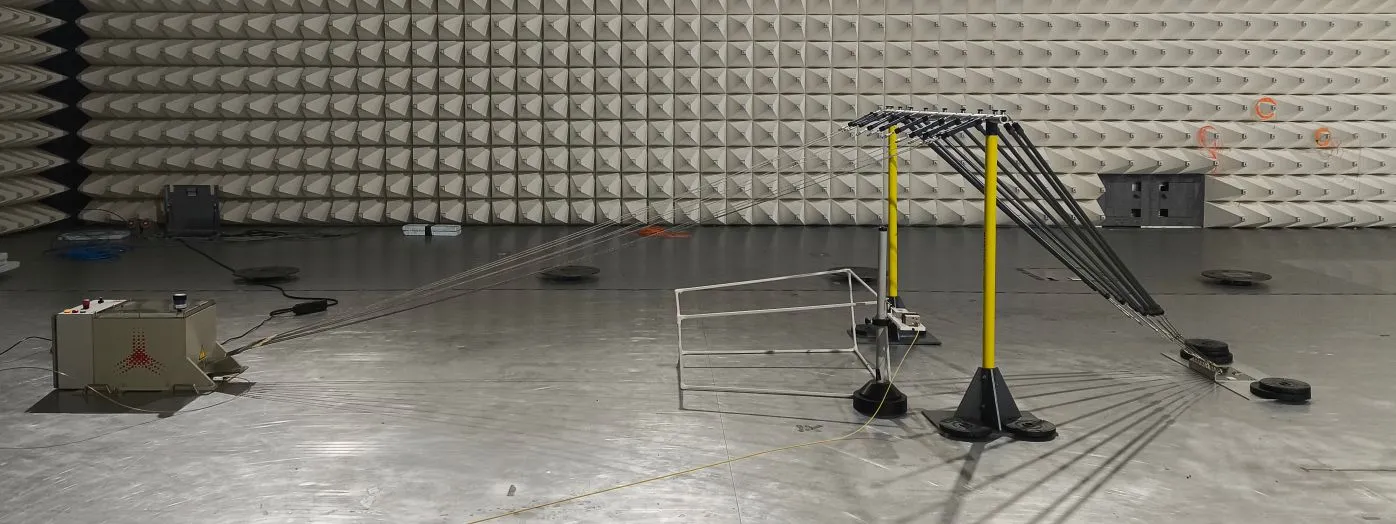
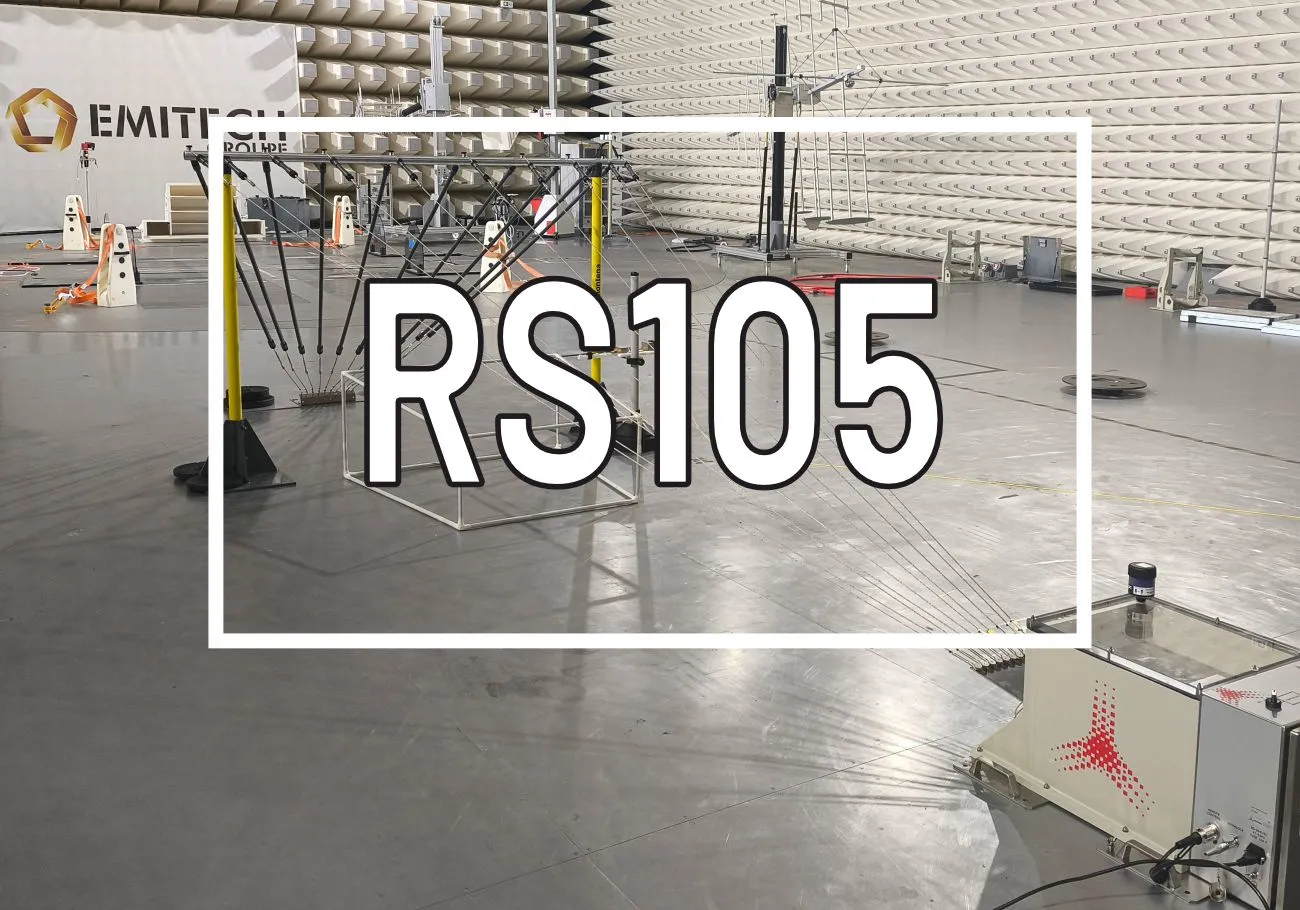
The Emitech Group carries it out with its own test facility at Montigny-le-Bretonneux, near Paris:
- Peak electric field of 50,000 V/m
- Rise time of 1.8 to 2.8 ns and full width at half maximum of 23 ns ± 5 ns
- Can be integrated into your military EMC test campaign
Can your equipment be tested?
Test volume
The test volume of our transmission line widens and rises as it moves away from the generator:
- Length: 1,000 mm
- Width: 750 to 1,000 mm
- Height: 340 to 450 mm
Test conditions
- Standards: RS105 (MIL-STD-461) and NRS03 (AECTP-500), to the revision or edition in your specification
- Field level: all levels from 1,000 V/m to 50,000 V/m
- Facility: 80 kV pulse generator and 6-metre parallel-plate transmission line (stripline)
- Location: very large EMC chamber at Montigny-le-Bretonneux, France, and other system chambers
- Operation: equipment powered and monitored during and after each pulse
- Duration: standard two-day format, including installation, calibration and dismantling, to be confirmed for your configuration
From your specification to the test report
Which equipment is concerned?
MIL-STD-461 is a US standard, but its use extends well beyond the United States: it is one of the main EMC references within NATO, and AECTP-500 includes the NRS03 test derived from it. RS105 can therefore be required by a European, UK or other allied programme.
The test targets equipment and subsystem enclosures exposed to the external electromagnetic environment where the programme sets an EMP requirement, as well as equipment inside poorly shielded or unshielded platforms:
- Surface ships: external, above-deck and exposed below-deck installations
- Aircraft: in particular safety-critical equipment in an external installation
- Submarines, ground installations and space systems: according to programme requirements
The standard does not make RS105 applicable by default on any platform: it is either limited to specific cases or left for the procuring activity to specify. Your specification therefore decides, whichever country the programme belongs to. Our experts can review it with you.
Key technical points
- Field verified at five grid points with a B-dot or D-dot probe, between 0 and 6 dB above the limit
- First pulse at 10% of the required level, then increased in steps
- At least five pulses, at no more than one per minute
- Criterion: no malfunction or performance degradation beyond the tolerances in the specification
Your test in four steps
- Review of your specification and preparation of the test plan
- Installation of the equipment and verification of the field
- Application of the pulses and functional monitoring
- Analysis of the results and delivery of the report
Talk to our RS105 experts
Your test report
- Photographs of the equipment, cables and setup for each orientation
- Detailed description of the configuration
- Oscilloscope recordings: peak value, rise time and pulse width
- Pulse numbering and time to recovery after any failure
- Test volume dimensions and probe position
Add RS105 to your qualification campaign
RS105 assesses the susceptibility of the equipment to a transient electromagnetic field, with cabling arranged to meet the test requirements. MIL-STD-461 deals with cable coupling under CS116, which we also carry out. Depending on your programme, you can group these tests with the rest of your campaign:
- MIL-STD-461 and AECTP-500: emissions, conducted and radiated susceptibility
- MIL-STD-704: power supply testing
- MIL-STD-810, 202 and 883: climatic and mechanical testing
- Engineering: requirements analysis, qualification plans and test procedures
A test facility of our own
The system belongs to the Emitech Group and is operated by our teams, with no external laboratory involved. It takes 2 hours to install and 1 hour to dismantle. It can be deployed in other shielded chambers of suitable size once the calibration has been checked.
Prepare your feasibility request
- Equipment dimensions and mass
- Standard, revision or edition, and required field level
- Installation configuration: ground plane or isolated support
- Cables and interfaces to keep operating during the test
- Operating criteria and monitoring arrangements
Why choose the expertise of the Emitech Group?
- Testing carried out in France by our own teams, with no external laboratory involved
- A single technical contact for your military EMC campaign
- Over 30 years’ experience in qualification for the defence sector
- A provider recognised by major contractors (Thales, Safran, MBDA, KNDS, Dassault, Airbus DS, Airbus Helicopters, etc.)
- A rare ability to combine DO-160, MIL-STD and civil standards testing
RS105 testing: frequently asked questions
What is the RS105 test?
RS105 is the MIL-STD-461 radiated susceptibility test for transient electromagnetic fields. It verifies that military equipment withstands a 50,000 V/m electromagnetic pulse (EMP) with no malfunction or performance degradation beyond the tolerances in its specification.
Does my equipment need RS105 testing?
Your equipment needs it if your programme sets an EMP requirement, whichever country the programme belongs to. The test targets equipment and subsystem enclosures exposed to the external electromagnetic environment, or installed in poorly shielded or unshielded platforms. MIL-STD-461H does not make it applicable by default on any platform: depending on the platform, it is limited to specific installations or left for the procuring activity to specify.
Does RS105 apply outside the United States?
Yes, whenever the programme specification requires it. MIL-STD-461 is a US standard, but it is one of the main EMC references within NATO, and AECTP-500 includes the NRS03 test derived from RS105.
What equipment size can you test?
Our test volume is 1,000 mm long, 750 to 1,000 mm wide and 340 to 450 mm high. For testing in all three orientations, allow around 400 mm in the largest dimension. Larger equipment, up to 1,000 × 750 × 340 mm, is reviewed according to the orientations required.
How does RS105 relate to NRS03?
NRS03 in AECTP-500 is the NATO test derived from RS105 in MIL-STD-461. We carry out both with the same test facility. Your specification sets the reference, edition and level that apply, and our teams review them to define the test configuration.
What is the difference between RS105 and CS116?
RS105 exposes the equipment to a radiated field, while CS116 addresses transients coupled onto cables. MIL-STD-461 assigns equipment responses caused by cable coupling to CS116. The two tests are complementary and can be included in the same campaign, depending on your programme requirements.
Is RS105 a HEMP test?
RS105 reproduces the fast component of a nuclear EMP, known as E1 in the case of a high-altitude burst (HEMP). It is an equipment-level, radiated-field test. It does not replace the demonstration of protection for a complete facility, which falls under other standards such as MIL-STD-188-125.
How long does RS105 testing take?
RS105 testing is offered in a standard two-day format, including installation, calibration and dismantling. The duration is confirmed according to the equipment dimensions, the number of orientations and the monitoring required.
Related Services



Needs
Discover a selection of additional resources that explore topics related to this page including regulatory contexts, technical articles, and specific areas of expertise. These materials provide further insight to help you better understand the key challenges and available solutions.


Get the feasibility of your RS105 / NRS03 test checked
Send us your equipment dimensions, the applicable standard and the required field level. Our technical and project teams will review your request and design an optimised test campaign.